How Blockchain Works: A Simple Explanation for Those Just Starting Out
We explain how blockchain works in simple terms: what blocks are, why data cannot be changed, what miners do and how this connects to buying cryptocurrency through Paybis.
The word "blockchain" comes up everywhere when people talk about cryptocurrency. But what is it really, and why does it matter? Most explanations are either too technical or too vague. This article explains how blockchain works through straightforward analogies — clearly enough for anyone, regardless of technical background.
The Problem Blockchain Solves
Start with the task. Imagine you need to transfer money to another person without involving a bank. How does that person know you actually have the funds and are not trying to spend the same money twice?
Traditionally, this problem is solved by a bank — a trusted intermediary that maintains a shared ledger and tracks balances. You trust the bank, and the bank watches the record book.
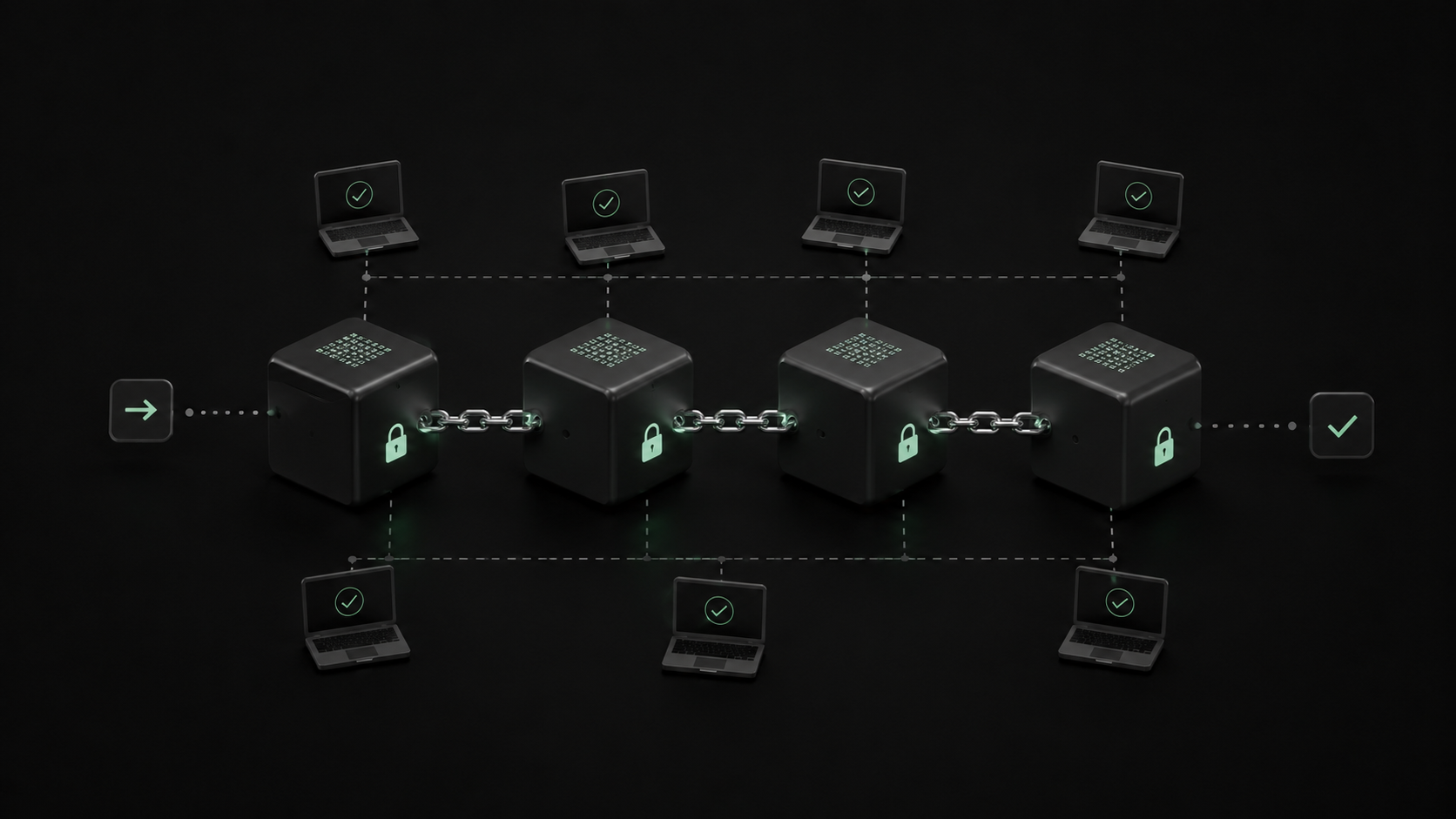
Blockchain solves the same problem without a central intermediary. Instead of one bank ledger, there are thousands of identical copies stored simultaneously by thousands of independent participants across the network. Nobody owns this ledger — it belongs to the entire network.
What a Block Is and Why It Is a Chain
Blockchain literally means "chain of blocks". Let us break down both words.
A block is a batch of transactions. When several transactions occur on the Bitcoin network — say, 2,000 transfers over a few minutes — they are grouped into one block. Each block contains a list of transactions, a timestamp and a special identifier called a hash.
A hash is the unique digital fingerprint of a block. It is a long string of letters and numbers generated from the block's contents using a mathematical algorithm. If even a single character in the block changes, the hash changes completely. It is like a fingerprint: unique and instantly different if anything is altered.
A chain is how blocks are linked together. Every new block contains the hash of the previous block. That is the chain: each link references the one before it.
This is precisely what makes a blockchain resistant to tampering. If someone wanted to falsify an old transaction, they would have to recalculate the hash of the altered block, then all subsequent blocks, and do it faster than all other participants in the network add new blocks. In practice, this is mathematically impossible in a sufficiently large network.
Who Adds Blocks: Miners and Validators
New blocks are not added automatically — participants in the network handle this.
In Bitcoin, these are miners. They solve a complex mathematical puzzle — finding a special number (nonce) such that the block's hash begins with a certain number of zeros. This requires enormous computing power. Whoever solves the puzzle first adds the block to the chain and receives a reward in newly created Bitcoin. This is called Proof-of-Work.
In Ethereum, after its transition to Proof-of-Stake in 2022, blocks are added by validators — participants who have locked (staked) a certain amount of ETH as a guarantee of honest behaviour. A randomly selected validator proposes a new block, others verify and confirm it. A dishonest validator loses their stake. This requires far less energy than mining.
Both mechanisms solve the same problem: how to reach agreement in a decentralised network with no single controller.
Why Transactions Are Irreversible
This property of blockchain matters when buying cryptocurrency — and explains why you must check a wallet address before sending funds.
Once a transaction is included in a block and subsequent blocks reference that block, changing it is practically impossible. Not because rules prohibit it, but because it is mathematically unrealistic without rewriting the entire subsequent chain.
This is why cryptocurrency sent to a wrong address after a Paybis purchase cannot be returned. There is no cancellation mechanism — only the sender could voluntarily return the funds if they were known.
The Public Nature of Blockchain: Anyone Can Verify
Another important property: most blockchains are public. Anyone can open a blockchain explorer and look up any transaction — how much was sent, from which address, to which address, at what moment.
This does not mean transactions are linked to names. A wallet address is simply a string of letters and numbers. Who stands behind it — the blockchain does not know. This is called pseudonymity: transactions are visible, identities are not.
This is why, after a purchase through Paybis, you can independently verify the movement of funds using the transaction hash in a blockchain explorer — no need to take the platform's word for it, everything is verifiable independently.
How This Connects to Buying on Paybis
When you buy Bitcoin or Ethereum through Paybis, here is what happens.
Paybis creates a transaction: send a certain amount of coins from the platform's wallet to your address. The transaction is broadcast to the network. Miners or validators include it in the next block. The block is added to the chain. After several confirmations — several subsequent blocks — the transaction is considered final and the funds appear in your wallet.
This entire process happens without banks, without business hours, without borders. The network operates 24 hours a day, 7 days a week, anywhere in the world.
That is the essence of the technology: trust is provided by mathematics and decentralisation rather than the reputation or regulation of a specific intermediary.