How to Store Cryptocurrency Safely: Hot and Cold Wallets
We explain how to safely store cryptocurrency after purchase: hot and cold wallets, seed phrase, basic security rules. A simple guide for beginners.
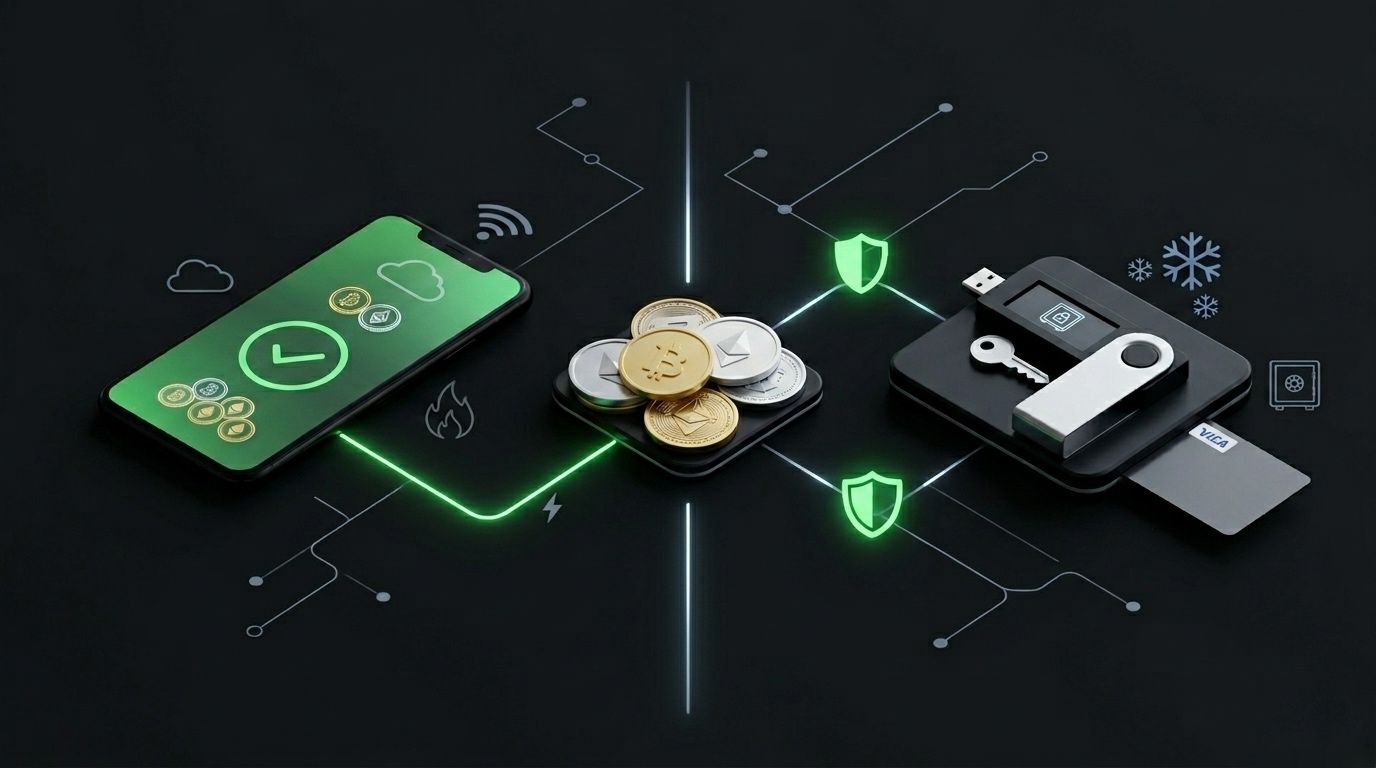
Buying cryptocurrency is only the first step. The next question that arises immediately is where and how to store it so you do not lose it. Unlike a bank account, there is no support service that will restore your access if something goes wrong. Cryptocurrency security is your responsibility. But understanding the basic principles is not difficult.
The Core Principle: Whoever Holds the Keys Owns the Crypto
This is the foundation to understand before everything else.
Cryptocurrency is not stored "in an app" or "on an exchange". It exists on the blockchain — a public transaction ledger. An app or device simply holds the keys that allow you to manage the funds at a specific address.
There are two fundamentally different approaches to storing keys.
Custodial storage — where keys are held by a third party: an exchange, a platform, a service. You log in with a username and password. It is convenient, but it means you do not own the crypto directly — you own the platform's obligation to you. If the platform is hacked, goes bankrupt, or blocks your account, access to your funds may be lost.
Non-custodial storage — where the keys are held by you. No one other than you has access to them. You bear full responsibility for keeping them safe, but you also have full control over your assets.
Paybis operates on a non-custodial model: after purchase, cryptocurrency is sent directly to your personal wallet. This is the right starting point.
Hot Wallets: Convenience for Everyday Use
A hot wallet is an application that is constantly or regularly connected to the internet. A mobile app on your phone, a browser extension, a program on your computer.
The main advantage is convenience. Sending or receiving cryptocurrency takes a few taps. Your balance is always visible. It works anywhere there is internet.
The main risk is the network connection. A device with a hot wallet is potentially vulnerable to malware, phishing attacks and hacks. If your smartphone is infected with a virus or you accidentally entered your seed phrase on a fake website, your funds could be stolen.
Who hot wallets are right for: small amounts used regularly. Think of it like cash in your wallet — convenient to carry, but not where you keep all your savings.
When buying through Paybis, cryptocurrency initially arrives in a mobile non-custodial wallet — this is a hot wallet. For a start, this is fine. As the amount grows, it is worth considering more secure storage.
Cold Wallets: Maximum Security for Serious Amounts
A cold wallet is a way of storing keys without a permanent internet connection. The keys are physically isolated from the network, making them unreachable by online attacks.
A hardware wallet is a specialised physical device about the size of a USB flash drive. Private keys are stored inside a secure chip and never leave the device. To make a transaction, the device is connected to a computer, the transaction is signed inside the device and sent to the network — the keys are never transmitted anywhere. Even if the computer is infected with a virus, the keys remain safe.
A paper wallet is a printed or handwritten private key and address. The simplest form of cold storage. Completely protected from online threats but physically vulnerable: it can burn, get wet, or be lost. Not recommended as a primary storage method.
Who cold wallets are right for: significant amounts that you do not plan to spend in the near future. If you are holding cryptocurrency as a long-term investment, a hardware wallet is justified.
Seed Phrase: The Most Important Thing to Protect
Regardless of the type of wallet — hot or cold — there is one thing more important than anything else. The seed phrase.
A seed phrase (mnemonic phrase) is 12 or 24 words generated when a wallet is created. It is not a password or a PIN code. It is a master key from which all the wallet's keys are mathematically derived. Whoever holds the seed phrase controls all the funds in that wallet.
Three rules that must never be broken.
First — never enter your seed phrase in digital form. Do not photograph it, do not save it in notes, do not send it via messenger, do not enter it on any website. The only place a seed phrase should exist is on a physical medium that has never touched the internet.
Second — write it down on paper and keep it in a safe place. Ideally two copies in different physical locations. Some people keep it in a fireproof safe or a bank safety deposit box.
Third — never share your seed phrase with anyone. Not with support services, not with "wallet representatives", not with anyone. No legitimate service will ever ask for a seed phrase. This is a one hundred percent sign of fraud.
Practical Security Rules
A few simple rules that significantly reduce risks.
Use different devices for different purposes. The device on which a wallet is stored is better not used for downloading files from unverified sources or visiting suspicious websites.
Enable additional protection. Most mobile wallets offer the option to set a PIN code or biometric authentication for login. This does not protect against seed phrase theft but protects against unauthorised access to the phone.
Check addresses before sending. When copying an address, malware can substitute it in the clipboard. Always check the first and last few characters of an address after pasting.
Do not keep large amounts on exchanges. Exchange wallets are custodial — you do not control the keys. Exchanges get hacked, they go bankrupt, they block withdrawals. Buying on an exchange is convenient, but storing is better done in your own wallet.
Be careful with phishing. Fraudsters create exact copies of legitimate wallet sites and platforms. Always check the URL, use bookmarks for frequently visited crypto services and never follow links from emails or messages.
How to Choose a Wallet for Storage After Buying on Paybis
When buying through Paybis, cryptocurrency is sent to the address you provided. If that is a mobile non-custodial wallet, this is a good starting point.
For small amounts and regular use, a mobile non-custodial wallet is perfectly suitable. The key points: write down your seed phrase, do not keep the wallet on a device with malware, enable PIN protection.
For storing more significant amounts that you do not plan to spend in the near future, consider a hardware wallet. It is a one-time investment that provides a fundamentally different level of protection.
The basic rule that works for most people: a small amount for everyday transactions in a hot wallet, the main part of your savings in a cold one.